
Tourism at Wudang Mountain
WUDANG MOUNTAIN
The Cradle of Tai Chi & The First Immortal Mountain
1. Mysterious & Ethereal Fairyland
Wudang Mountain seamlessly harmonizes stunning natural landscapes with rich cultural heritage, earning the ancient praise of "the unparalleled scenic spot and the first immortal mountain in the world."
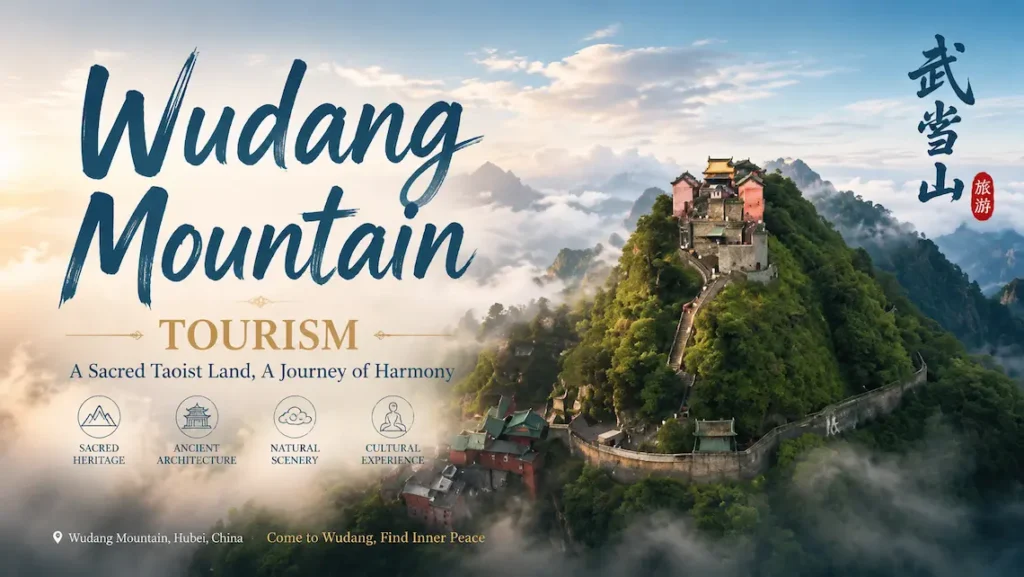
The landscape is a majestic display of nature's wonders, defined by the "72 peaks facing the top and 24 streams flowing." Its highest peak, Tianzhu Peak, rises 1,612 meters as a natural "pillar supporting the sky." Shrouded in dense purple clouds and unpredictable mists year-round, the mountain is home to breathtaking phenomena such as "Thunder Fire Refining Hall" and "Sea Horse Spitting Fog," creating an ethereal, heavenly atmosphere.
2. Wudang Martial Arts: The Inner Spirit
As the ultimate symbol of internal martial arts (Neijia), Wudang Wushu is deeply rooted in Taoist philosophy, specifically the principles of the Book of Changes and inner alchemy. Founded by the legendary Taoist priest Zhang Sanfeng, it established Tai Chi as a premier practice for both self-defense and health longevity.
- Core Philosophy: Follows "Tao follows nature," utilizing the balance of Yin and Yang, the evolution of the Eight Diagrams (Bagua), and the Five Elements.
- Technique & Style: Characterized by overcoming hardness with softness, redirecting "four ounces to move a thousand pounds," and moving gracefully like floating clouds and flowing water. It stands as a pillar of Chinese martial arts, celebrated as "Shaolin in the north, Wudang in the south."
3. Wudang Culture: The Soul of Tradition
Wudang Mountain stands at the pinnacle of China's four sacred Taoist mountains. Its religious significance began as early as the Spring and Autumn Period, flourishing through the Tang, Song, and Yuan dynasties as emperors bestowed divine titles upon the Wudang Zhenwu God.
During the Ming Dynasty, Emperor Yongle escalated Wudang's status to the "Supreme Royal Temple," commanding over 30,000 soldiers and artisans to conduct a massive 12-year overhaul. This grand project resulted in a sprawling complex of 33 architectural groups—including 9 palaces, 8 temples, 36 testimonies/nunneries, and 72 rock temples—stretching over 140 miles.
4. Architectural Marvel: The Forbidden City on a Cliff
Designed to mirror the legendary spiritual cultivation of the Zhenwu God, the architecture strictly adheres to the imperial royal standard. Celebrated as "a museum of ancient Chinese architectural achievements" and the "Forbidden City hanging on the cliff," the complex perfectly embodies the core Taoist ideal of "harmony between man and nature." It remains the largest religious architectural complex in the world today.