
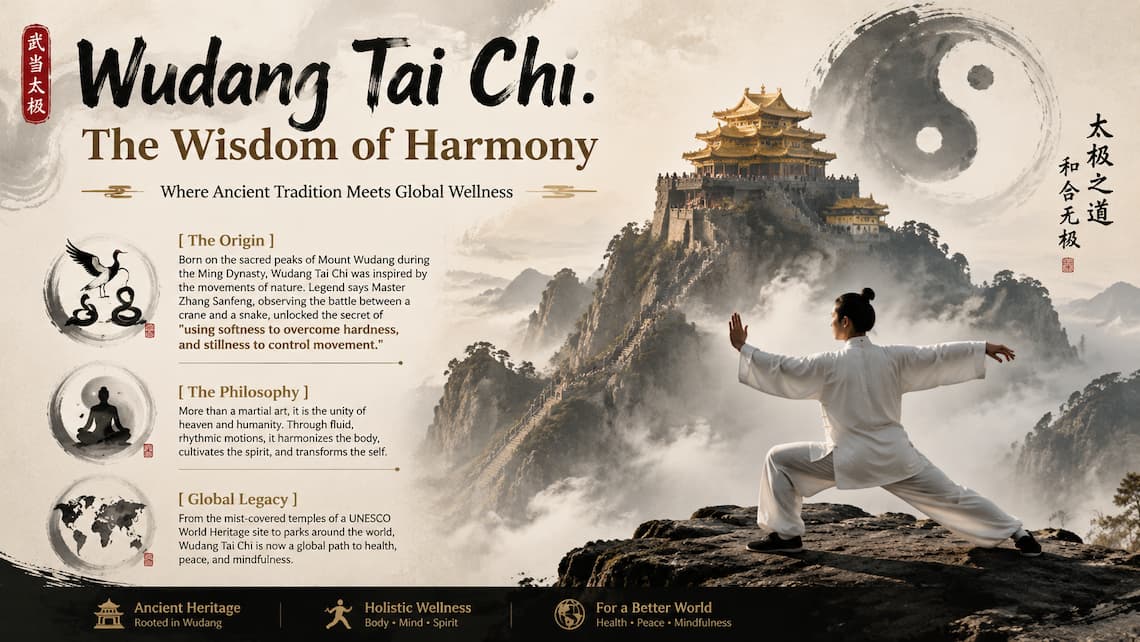
Wudang Tai Chi: The Flow of Ancient Eastern Wisdom
From the Sacred Peaks of Taoism to a Globally Recognized Healthy Lifestyle
Wudang Tai Chi originated on Mount Wudang, a sacred site of Chinese Taoist culture. Legend has it that during the Ming Dynasty, the Taoist master Zhang Sanfeng, while practicing asceticism on Mount Wudang, observed a crane and a snake fighting and thereby grasped the martial philosophy of “using softness to overcome hardness, and stillness to control movement.”
By integrating Taoist concepts of yin and yang with traditional boxing techniques, Master Zhang Sanfeng gradually developed Wudang Tai Chi. It emphasizes the “unity of heaven and humanity,” featuring fluid and gentle movements that cultivate both the inner self and the body. It is not merely a martial art but also an Eastern philosophy for self-cultivation and spiritual refinement.
Mount Wudang: The Foremost Sacred Mountain Under Heaven
Located in northwestern Hubei Province, Wudang Mountain boasts a continuous range of peaks and ancient, lush forests, earning it the reputation as “an unparalleled scenic wonder since time immemorial and the foremost sacred mountain under heaven.” It is not only one of the major birthplaces of Chinese Taoism but also a UNESCO World Heritage Site.
The mountain preserves a large number of Ming Dynasty Taoist temple complexes, with ancient structures such as the Golden Summit, Zixiao Palace, and Nanyan Palace built along the slopes, showcasing the unique charm of traditional Chinese architecture in harmony with the natural environment. For hundreds of years, Wudang Mountain has served as both a sacred site for Taoist cultivation and a vital center for the transmission of Chinese martial arts culture.
The Globalization of Tai Chi: A Modern Healthy Lifestyle
In modern times, Wudang Tai Chi has gradually gained global recognition. As cultural exchanges between China and the rest of the world deepen, an increasing number of foreigners are discovering and learning Tai Chi. Wudang Mountain actively promotes the “Globalization of Tai Chi” through international martial arts exchanges, overseas tours, international training programs, and online courses, spreading Wudang Tai Chi to Europe, the Americas, Southeast Asia, and many other countries and regions worldwide.
Many foreign students make special trips to Wudang Mountain to study martial arts and Daoist culture, and some countries have even established Wudang Tai Chi associations and martial arts centers. Today, Tai Chi is no longer merely a traditional Chinese sport; it has become a globally recognized healthy lifestyle.
Many people abroad believe that Tai Chi’s gentle movements and slow, rhythmic pace help reduce stress and improve physical coordination and mental well-being, making it particularly popular among middle-aged and elderly people, as well as yoga and meditation enthusiasts. In 2020, Tai Chi was inscribed on the UNESCO Representative List of the Intangible Cultural Heritage of Humanity, further enhancing global recognition of China’s Tai Chi culture.
From the ancient Taoist temples shrouded in mist on Wudang Mountain to the crowds practicing in parks around the world, Wudang Tai Chi is transcending national borders with its unique Eastern wisdom, serving as an important bridge connecting diverse cultures.