
Tai Chi for Beginners: The Essential Basic Training You Should Master First
Starting Tai Chi can feel simple because the movements are slow and gentle. However, traditional Tai Chi is a profound practice that combines body structure, breathing, balance, and mindfulness.
For beginners, the biggest mistake is trying to learn complicated Tai Chi forms too quickly. A strong foundation is the key to improving your movements, protecting your joints, and experiencing the true health benefits of Tai Chi.
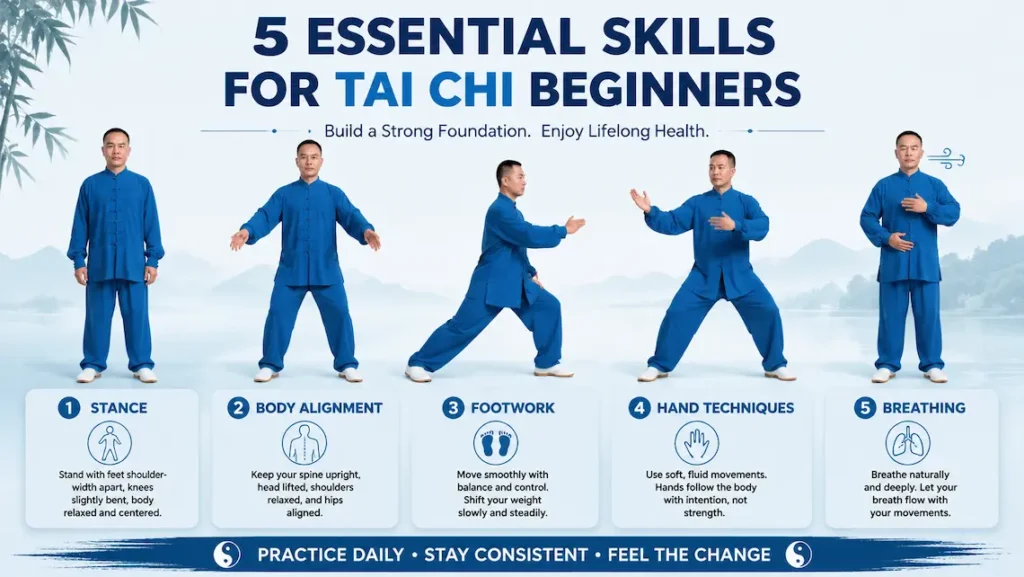
Before learning advanced forms such as the 24 Form Tai Chi or 42 Form Tai Chi, beginners should focus on several essential Tai Chi basic training exercises.
1. Standing Meditation (Zhan Zhuang): The Foundation of Tai Chi Practice
In Tai Chi training, there is an old saying: "Practice standing before practicing movement."
Zhan Zhuang, also known as standing meditation, is one of the most important Tai Chi beginner exercises. Although it looks simple, standing practice develops:
- Body stability and balance
- Leg strength and endurance
- Core control
- Relaxation ability
- Focus and mindfulness
How to Practice Standing Meditation:
- Stand with your feet shoulder-width apart
- Bend your knees slightly and relax your body
- Keep your spine naturally straight
- Relax your shoulders and neck
- Breathe naturally and calmly
Beginners can start with 5 minutes daily and gradually increase to 15-20 minutes. The goal is not to stand longer, but to develop a relaxed and stable body structure.
2. Learn Proper Tai Chi Body Alignment
Correct body posture is the foundation of effective Tai Chi training. Many beginners focus only on copying movements but ignore body structure.
Important Tai Chi principles include:
Relaxed Shoulders and Elbows
Avoid unnecessary tension. The shoulders should naturally drop and the arms should remain relaxed.
Spine Extension and Natural Posture
Keep your head lifted naturally while maintaining a comfortable and upright spine.
Relaxed Waist and Hip Movement
The waist and hips connect the upper and lower body. Learning to move from the center is an important skill in Tai Chi.
3. Tai Chi Footwork: Building Balance and Stability
Tai Chi is not only about hand movements. The ability to transfer weight smoothly is one of the most important skills for beginners.
Beginners should practice:
- Forward stepping
- Backward stepping
- Side stepping
- Weight shifting between legs
Tai Chi teaches the concept of "empty and full." One leg supports the body while the other moves freely. This improves balance, coordination, and body awareness.
4. Basic Tai Chi Movements: Connecting the Whole Body
After developing basic posture and footwork, beginners can start practicing simple Tai Chi movements.
Cloud Hands (Yun Shou)
Cloud Hands is one of the most famous Tai Chi movements. It helps beginners develop:
- Hand and body coordination
- Waist rotation
- Balance control
- Smooth continuous movement
The hands should not move independently. The movement should be guided by the waist and supported by the legs.
Grasp the Sparrow's Tail (Lan Que Wei)
This fundamental Tai Chi sequence includes several important techniques:
- Peng (ward off)
- Lu (roll back)
- Ji (press)
- An (push)
It represents the Tai Chi principle of using softness, balance, and controlled strength.
5. Breathing Practice: Creating Harmony Between Body and Mind
One of the reasons people practice Tai Chi is to improve relaxation and mental balance.
Beginners should not force special breathing techniques. Instead:
- Keep breathing natural
- Relax the body during movement
- Coordinate breathing with slow movements
Over time, breathing and movement will naturally become more connected.
A Simple Daily Tai Chi Beginner Training Plan
| Training Time | Practice |
|---|---|
| 5 minutes | Standing Meditation (Zhan Zhuang) |
| 5 minutes | Body alignment and relaxation practice |
| 5 minutes | Basic Tai Chi stepping exercises |
| 5 minutes | Simple movements and breathing |
Common Mistakes Tai Chi Beginners Should Avoid
1. Learning Forms Too Quickly
Many beginners want to immediately learn complete Tai Chi routines. However, without basic training, movements may look correct but lack internal connection.
2. Focusing Only on Appearance
Tai Chi is not about performing beautiful movements. The most important things are relaxation, balance, and coordination.
3. Practicing Without Consistency
Tai Chi results come from regular practice. Practicing 15 minutes every day is often more beneficial than practicing for two hours once a week.
Frequently Asked Questions About Starting Tai Chi
Q1: How long does it take to learn Tai Chi as a beginner?
Most beginners can learn basic Tai Chi movements within a few weeks, but developing true body awareness and skill requires consistent practice over months and years.
Q2: Can older adults start learning Tai Chi?
Yes. Tai Chi is a low-impact exercise suitable for many age groups. Its gentle movements can help improve balance, flexibility, and overall wellness.
Q3: Should beginners learn Tai Chi at home?
Beginners can practice basic exercises at home, especially with reliable instruction. However, learning from experienced teachers can help correct posture and movement details.
Conclusion: Build Your Tai Chi Foundation Step by Step
Learning Tai Chi is a journey of patience and consistency. The correct order for beginners is:
Standing Meditation → Body Alignment → Footwork → Basic Movements → Complete Tai Chi Forms
By building a strong foundation, beginners can enjoy the physical and mental benefits of Tai Chi while developing lifelong health habits.
Whether your goal is improving flexibility, reducing stress, enhancing balance, or exploring traditional Chinese culture, Tai Chi can become a valuable practice for your daily life.