
Understanding “Relaxation” and “Sinking” in Tai Chi
Tai Chi emphasizes "relaxation" and "sinking," which are the two elements that every beginner first experiences during practice—and which are also the most confusing. Many people find that when they practice, their shoulders involuntarily hunch up, their lower abdomen tenses, their movements become stiff, and it seems difficult for their qi and blood to sink down to the dantian. Today, let’s discuss how to truly experience “relaxation” and “sinking” in Tai Chi, so that your movements flow naturally and your breath remains unobstructed.
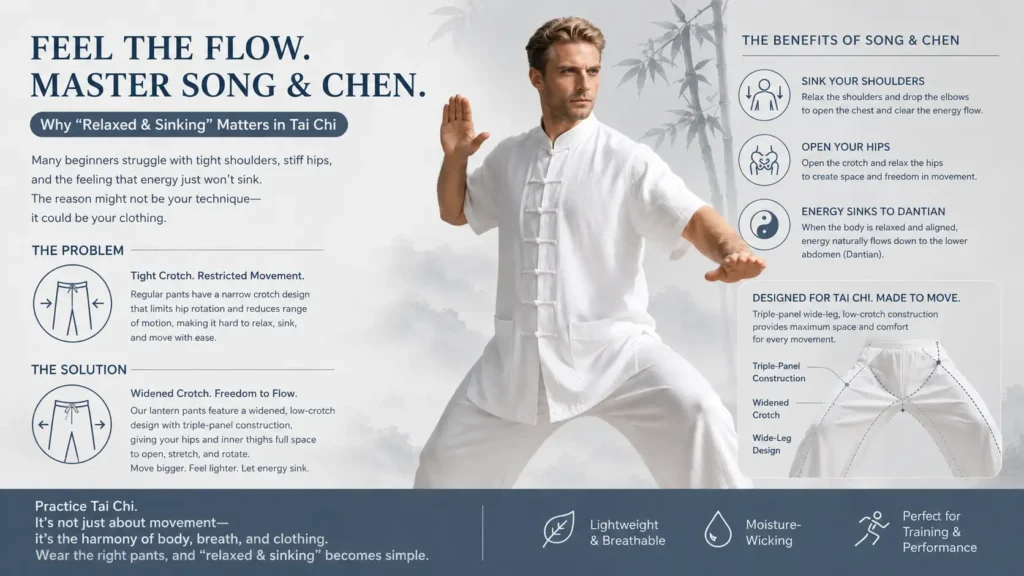
I. Shoulders Should Sink, Groin Should Open
When practicing Tai Chi, the shoulders need to sink naturally, creating a state of “sinking shoulders and dropping elbows.” This reduces tension in the upper body, allowing qi to flow smoothly from the shoulders and neck down to the Dan Tian. At the same time, the groin needs to open naturally, and the body must not be stiff. Only then can flexibility be maintained during movement transitions, and qi and blood can circulate smoothly.
Many beginners, when practicing “opening the hips and lowering the pelvis” or taking large strides (such as in the “Sparrow on the Ground” form), often feel tension in their lower limbs and struggle to achieve true “relaxation.” In fact, this discomfort isn’t entirely due to incorrect form; sometimes, your pants are “giving you away.”
II. Clothing Cut Also Affects “Looseness and Sinking”
The crotch area of ordinary jeans or sweatpants is typically designed to be tight, which can restrict hip rotation and the extension of the inner thighs. This restriction makes it difficult to fully relax, preventing qi and blood from sinking smoothly.
Authentic Tai Chi attire features a key design element: a wide, low-rise crotch reminiscent of harem pants. For example, when designing our Tai Chi pants, we specifically adopted a three-seam, wide-leg, low-rise design to provide ample “breathing space” for the inner thighs and crotch area.
Whether performing wide, sweeping steps or transitions between solid and empty postures, your movements will not be restricted by your clothing. Only then can you truly experience the sensation of “relaxation and sinking.”
III. Tips for Experiencing “Relaxation and Sinking”
Start with the shoulders: Begin your practice with shoulder-relaxation exercises, allowing your shoulders to sink naturally and your elbows to hang slightly downward.
Relax the Groin: When attempting wide strides or shifting steps, ensure the groin remains loose and naturally extended.
Deep Breathing for Sinking: As you inhale, feel the energy rise; as you exhale, imagine it sinking into the Dan Tian, allowing your body to naturally relax and sink.
Check Your Clothing: Wearing loose-fitting Tai Chi pants with a well-designed low-rise crotch can significantly enhance both the comfort and precision of your movements.
IV. Summary
When first learning Tai Chi, experiencing the concepts of “relaxation” and “sinking” depends not only on the movements themselves but also on the coordination between your body and your clothing. Only when your shoulders are relaxed, your hips are open, and your qi and blood flow smoothly can you truly enjoy the sense of expansion and inner strength that Tai Chi brings.
Choosing the right pair of Tai Chi pants will make every transition between empty and full postures feel more natural, allowing “relaxation and sinking” to become a genuine sensation during your practice.
Remember, the beauty of Tai Chi lies not only in the fluidity of the movements, but also in the harmonious unity of the body and breath, and of the clothing and the flow of energy.