The Symphony of Stillness and Motion: Navigating the Nuances Between Tai Chi and Martial Arts
Published in Blog | Tags: Traditional Culture, Kung Fu, Wellness, Martial Arts
If you take a stroll through a local park at dawn, you will likely see groups of people slowly and gracefully moving through the flowing forms of Tai Chi. Switch the scene to a gymnasium or an action movie, and you are greeted with the high-flying, explosive, and fiercely dynamic movements of traditional martial arts. This striking contrast often leads to a common question: "Is Tai Chi actually a martial art?" or "What exactly is the difference between Tai Chi and martial arts?" Today, we are diving deep into these two captivating aspects of traditional Chinese culture to untangle the terminology and explore their shared roots.
1. Clarifying the Concepts: The Part vs. The Whole
First and foremost, we must establish a foundational truth: Tai Chi is not separate from martial arts; it is a major and highly respected school within it.
The term "martial arts" (or Wushu/Kung Fu) is a macro-level umbrella encompassing all traditional offensive and defensive techniques—kicking, striking, wrestling, and grappling. It is broadly categorized into internal styles (like Tai Chi, Xing Yi, and Bagua) and external styles (like Shaolin, Chaquan, and Hung Gar). Therefore, comparing "Tai Chi" to "martial arts" is essentially comparing the "part" to the "whole." However, in modern everyday conversation, when people say "martial arts," they are typically referring to the fast, explosive routines or combat sports. Using this popular context, we can draw fascinating comparisons between Tai Chi and these broader, more vigorous martial disciplines.
2. The Core Similarities
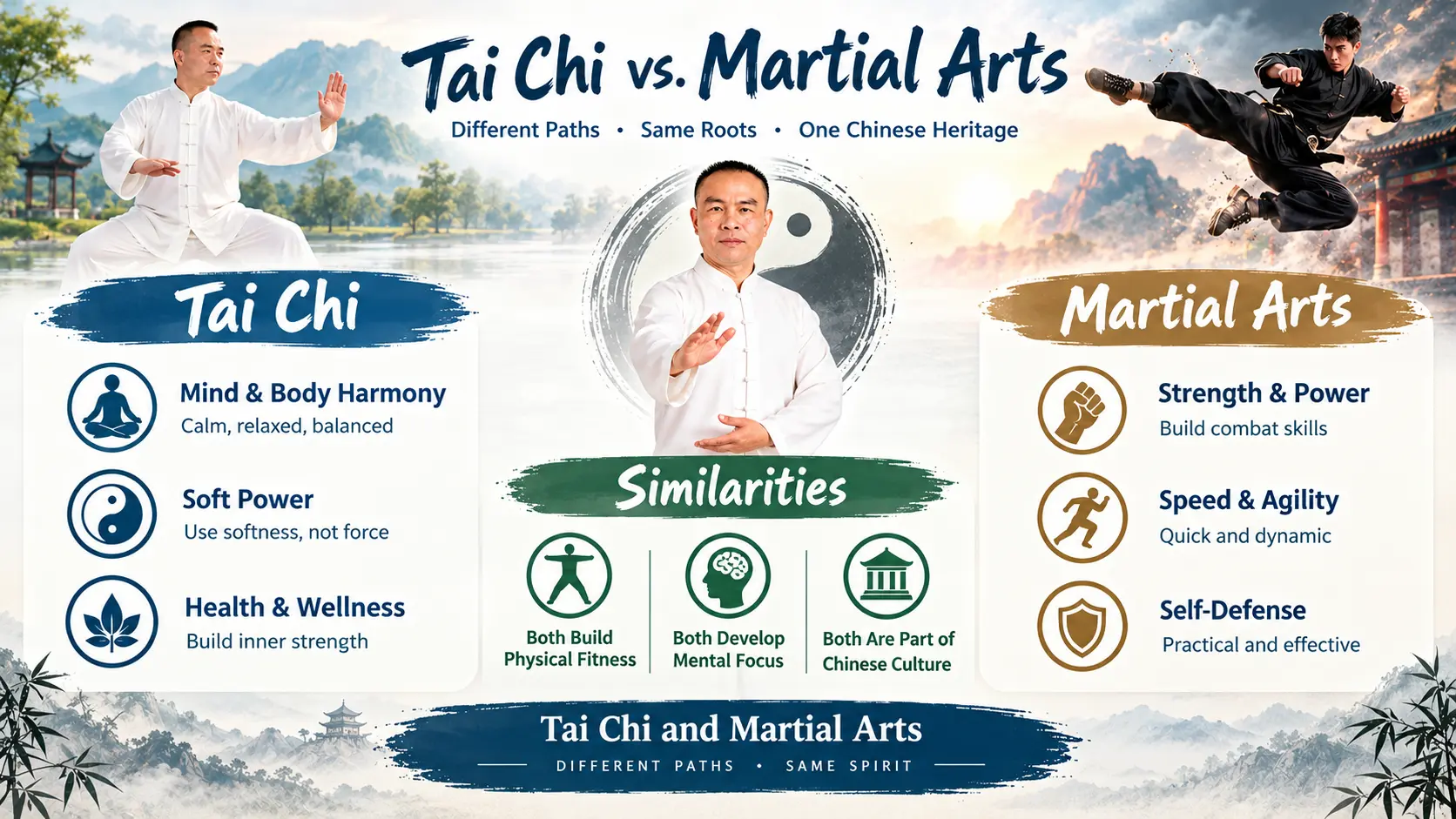
- Shared Cultural and Philosophical Roots: Both Tai Chi and other martial arts are deeply anchored in traditional Chinese philosophy. They emphasize concepts like "Qi" (vital energy), "Yin and Yang," and the harmony between humanity and nature. Both require a strict adherence to martial ethics (Wude) and personal character development.
- Internal and External Cultivation: Authentic traditional martial arts are never just about building raw muscle. Like other styles, Tai Chi demands the synchronization of breath, intention, and physical movement—what practitioners call unifying the mind, breath, and body.
- Inherent Combat Application: Although Tai Chi is globally celebrated today for its health and wellness benefits, it was originally forged for hand-to-hand combat. Every single slow-motion gesture in Tai Chi (such as warding off, rolling back, pressing, and pushing) contains lethal, practical defensive and offensive applications, entirely mirroring the fundamental purpose of styles like Wing Chun or Shaolin Kung Fu.
3. Distinct Differences from Other Martial Disciplines
- Pacing and Power Generation:
This is the most visible difference to the untrained eye. External martial arts often operate on the principle that "speed defines the victor." Movements are aggressive, lightning-fast, and highly explosive, frequently featuring leaping and acrobatics. Tai Chi, conversely, relies on overcoming hardness with softness and finding stillness within motion. Daily practice is intentionally slow, continuous, and fluid, like drawing silk from a cocoon, focusing on hidden, structural power rather than brute force.
- Philosophical Approach to Training:
Most traditional martial arts begin with "hardness"—developing muscular strength, stamina, and speed before eventually seeking a relaxed, "soft" mastery years later. Tai Chi flips this script. As an internal art, it begins directly with "softness." Practitioners are taught to deeply relax the body (without collapsing), strip away stiff, clumsy force, and learn to "listen" to an opponent's center of gravity through touch, ultimately achieving a state where hardness and softness are perfectly balanced.
- Demographics and Modern Utility:
Modern competitive martial arts demand peak physical conditioning; the rapid directional changes and high-impact clashes are best suited for youth and highly athletic adults. Tai Chi's gentle, low-impact training methods make it incredibly joint-friendly. While younger practitioners use it to explore biomechanics and martial philosophy, it has simultaneously become the ultimate therapeutic exercise for older adults worldwide, aiding in longevity, balance, and chronic disease rehabilitation.
Tai Chi is a uniquely serene trail on the towering mountain of martial arts. While standard martial arts showcase a spirit of resilience, unyielding strength, and vigorous vitality, Tai Chi whispers the profound wisdom of restraint, yielding like water, and harboring immense power beneath a calm surface. Together—the hard and the soft, the explosive and the still—they form the complete, breathing soul of martial arts.
- Pacing and Power Generation:
This is the most visible difference to the untrained eye. External martial arts often operate on the principle that "speed defines the victor." Movements are aggressive, lightning-fast, and highly explosive, frequently featuring leaping and acrobatics. Tai Chi, conversely, relies on overcoming hardness with softness and finding stillness within motion. Daily practice is intentionally slow, continuous, and fluid, like drawing silk from a cocoon, focusing on hidden, structural power rather than brute force. - Philosophical Approach to Training:
Most traditional martial arts begin with "hardness"—developing muscular strength, stamina, and speed before eventually seeking a relaxed, "soft" mastery years later. Tai Chi flips this script. As an internal art, it begins directly with "softness." Practitioners are taught to deeply relax the body (without collapsing), strip away stiff, clumsy force, and learn to "listen" to an opponent's center of gravity through touch, ultimately achieving a state where hardness and softness are perfectly balanced. - Demographics and Modern Utility:
Modern competitive martial arts demand peak physical conditioning; the rapid directional changes and high-impact clashes are best suited for youth and highly athletic adults. Tai Chi's gentle, low-impact training methods make it incredibly joint-friendly. While younger practitioners use it to explore biomechanics and martial philosophy, it has simultaneously become the ultimate therapeutic exercise for older adults worldwide, aiding in longevity, balance, and chronic disease rehabilitation.