
Sweat in Summer, Balance Qi & Blood:
A Scientific Guide to Nutrition and Food Pairing for Tai Chi Practitioners
A harmonious integration of traditional dietary wisdom and modern sports science.
In the peak of summer, all living things flourish. Practicing Tai Chi during this season embodies the core principle of "seeking stillness within motion" and "guiding the physical body through internal Qi." However, the scorching heat and high humidity trigger accelerated metabolic rates, causing practitioners to sweat profusely. How can we utilize scientific dietary pairing to replenish what is lost during training, nourish our constitution, and leverage summer’s vitality?
To establish an effective dietary strategy, we must integrate rigorous evidence from both modern sports nutrition and traditional wellness philosophies.
1. Summer Tai Chi Nutrition Challenges: What Are We Depleting?
- Electrolyte and Fluid Depletion: Although Tai Chi is a low-to-moderate intensity aerobic exercise (with heart rates typically ranging between 100 – 130 bpm), fluid loss through sensible and insensible perspiration can still reach 500 – 1000 ml per hour in summer. Crucial ions such as sodium, potassium, and magnesium are depleted alongside water, serving as the primary cause of post-training muscle weakness, fatigue, and shortness of breath.
- Glycogen Consumption and Energy Strain: The deliberate slowness, deep diaphragmatic breathing, and prolonged static postures (Zhan Zhuang) in Tai Chi place sustained demands on slow-twitch muscle fibers (red muscles). This requires a highly stable, continuous delivery of blood glucose.
- Spleen and Stomach Weakness (Summer Fatigue): High ambient temperatures cause systemic vasodilation, redirecting blood flow toward the skin and away from the gastrointestinal tract. This reduces digestive enzyme activity, meaning that overly heavy or rich foods will overtax the digestive system rather than nourish it.
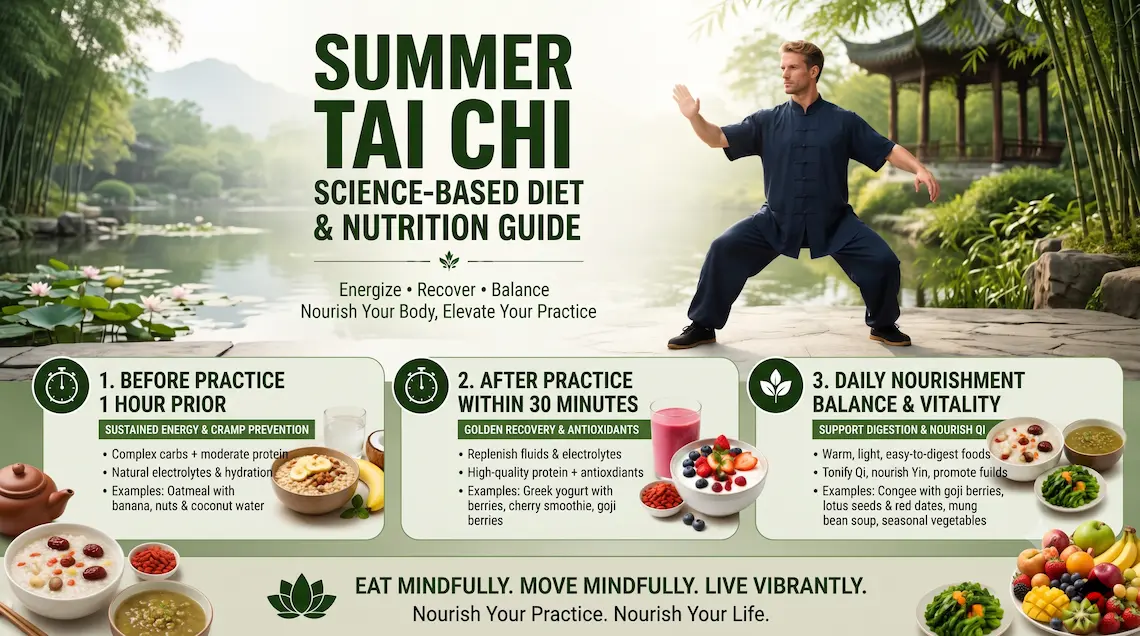
2. Three Golden "Tai Chi Dietary Pairing" Protocols
Protocol 1: 1 Hour Pre-Training — Sustained Energy & Cramp Prevention
Core Pairing: Oatmeal + Ripe Banana + Goji Berries
- Low-GI (Glycemic Index) Carbohydrates: Oats deliver a slow, sustained release of glucose into the bloodstream, maintaining stable blood sugar levels across 1 to 2 hours of movement and preventing mid-practice hypoglycemia.
- High-Potassium Support: Bananas are rich in potassium (approx. 358 mg per 100 g), which is essential for maintaining cellular membrane potentials and preventing skeletal muscle spasms (cramps) induced by heavy sweating.
- Trace Element Synergy: Goji berries contain betaine and specific polysaccharides. Phytochemical research indicates they help mitigate physical fatigue and improve cellular oxygen utilization under physical exertion.
Protocol 2: Within 30 Minutes Post-Training — Optimal Recovery & Antioxidants
Core Pairing: Mung Bean Soup with Lily Bulbs and Lotus Seeds (Low Sugar) + Steamed Fish or Tofu
- Synchronized Carbohydrate & Protein Synthesis: The 30-minute window following exercise is vital for muscle recovery. Fish or tofu delivers high-quality amino acids (proteins) which, when paired with the complex carbohydrates from lotus seeds and lily bulbs, rapidly accelerates glycogen replenishment and repairs microscopic muscle fiber tears.
- Mineral Replenishment & Heat Clearance: Mung bean skins are rich in isovitexin and flavonoids, providing potent antioxidant properties. The broth efficiently restores lost minerals while traditional theory values its capacity to clear summer damp-heat and protect internal fluids (Yin) from heat-induced exhaustion.
Protocol 3: Daily Constitution Regulation — Digestive Strength & Fluid Generation
Core Pairing: American Ginseng and Ophiopogon (Mai Dong) Pork Stew (or Chinese Yam, Poria, and Coix Seed Porridge)
- Modern Application of the Classic "Shengmai Formula": American ginseng (rich in ginsenosides) replenishes Qi and nourishes Yin while clearing empty heat; Ophiopogon supplements trace inorganic salts and plant mucilage. Pharmacological studies demonstrate that this synergy optimizes myocardial oxygen efficiency, making it ideal for practitioners who experience palpitations or shortness of breath after heavy sweating.
- Spleen Invigoration and Dampness Removal: Chinese yam (Shan Yao), Poria (Fu Ling), and Coix seeds (Yi Mi) are loaded with functional dietary fibers and natural amylases. They support a sluggish summer digestive tract, improving nutrient absorption efficiency.
3. The "Three Do's and Three Don'ts" of Summer Tai Chi Nutrition
Protocol 1: 1 Hour Pre-Training — Sustained Energy & Cramp Prevention
Core Pairing: Oatmeal + Ripe Banana + Goji Berries
- Low-GI (Glycemic Index) Carbohydrates: Oats deliver a slow, sustained release of glucose into the bloodstream, maintaining stable blood sugar levels across 1 to 2 hours of movement and preventing mid-practice hypoglycemia.
- High-Potassium Support: Bananas are rich in potassium (approx. 358 mg per 100 g), which is essential for maintaining cellular membrane potentials and preventing skeletal muscle spasms (cramps) induced by heavy sweating.
- Trace Element Synergy: Goji berries contain betaine and specific polysaccharides. Phytochemical research indicates they help mitigate physical fatigue and improve cellular oxygen utilization under physical exertion.
Protocol 2: Within 30 Minutes Post-Training — Optimal Recovery & Antioxidants
Core Pairing: Mung Bean Soup with Lily Bulbs and Lotus Seeds (Low Sugar) + Steamed Fish or Tofu
- Synchronized Carbohydrate & Protein Synthesis: The 30-minute window following exercise is vital for muscle recovery. Fish or tofu delivers high-quality amino acids (proteins) which, when paired with the complex carbohydrates from lotus seeds and lily bulbs, rapidly accelerates glycogen replenishment and repairs microscopic muscle fiber tears.
- Mineral Replenishment & Heat Clearance: Mung bean skins are rich in isovitexin and flavonoids, providing potent antioxidant properties. The broth efficiently restores lost minerals while traditional theory values its capacity to clear summer damp-heat and protect internal fluids (Yin) from heat-induced exhaustion.
Protocol 3: Daily Constitution Regulation — Digestive Strength & Fluid Generation
Core Pairing: American Ginseng and Ophiopogon (Mai Dong) Pork Stew (or Chinese Yam, Poria, and Coix Seed Porridge)
- Modern Application of the Classic "Shengmai Formula": American ginseng (rich in ginsenosides) replenishes Qi and nourishes Yin while clearing empty heat; Ophiopogon supplements trace inorganic salts and plant mucilage. Pharmacological studies demonstrate that this synergy optimizes myocardial oxygen efficiency, making it ideal for practitioners who experience palpitations or shortness of breath after heavy sweating.
- Spleen Invigoration and Dampness Removal: Chinese yam (Shan Yao), Poria (Fu Ling), and Coix seeds (Yi Mi) are loaded with functional dietary fibers and natural amylases. They support a sluggish summer digestive tract, improving nutrient absorption efficiency.
3. The "Three Do's and Three Don'ts" of Summer Tai Chi Nutrition
| Principle | Scientific Practical Guide |
|---|---|
| Warmth over Cold | Post-training bodies exist in a state of "external heat and internal cold." Consuming iced beverages causes sudden vasoconstriction of the gastric mucosa, which can trigger gastrointestinal spasms and trap metabolic heat internally. Opt for warm water or mild electrolyte solutions at 35°\text{C} – 40°\text{C}. |
| Frequent Sips over Gulping | Hydration must follow a "small volumes, high frequency" framework. Take 100 – 150 ml every 15–20 minutes during extended practice. Gulping massive volumes of water rapidly dilutes blood sodium levels, adding unnecessary burden to the cardiovascular and central nervous systems. |
| Clean Lightness over Heavy Fats | Summer dietary structures should reduce saturated fats (fatty meats, deep-fried foods) and prioritize high-quality lean proteins (eggs, dairy, fish, soy) paired with nutrient-dense, high-vitamin vegetables (leafy greens, bitter melon, winter melon). |
Conclusion
The essence of Tai Chi lies in the balance of Yin and Yang; similarly, summer nutrition demands a harmony between clearing heat and tonifying deficiencies. Relying solely on heavy proteins for "strength" or over-consuming cold herbal teas for "cooling" disrupts this equilibrium. By supporting your practice with low-GI carbs, repairing tissues with clean proteins, and soothing summer heat with mineral-rich fluids, you can cultivate an internal environment where Qi and blood flow smoothly all season long.
Join the Conversation: What is your go-to beverage or soup when practicing Tai Chi in the summer? Share your experiences below, and let's optimize your nutrition plan together!