Balancing Movement and Stillness, Integrating Inner and Outer: The “Three-Dimensional” Practice of Tai Chi for Health
In today’s fast-paced modern life, chronic diseases, anxiety, and suboptimal health have become the norm. How can we find an exercise that both strengthens the body and soothes the mind? Tai Chi for Health is an excellent “remedy.”
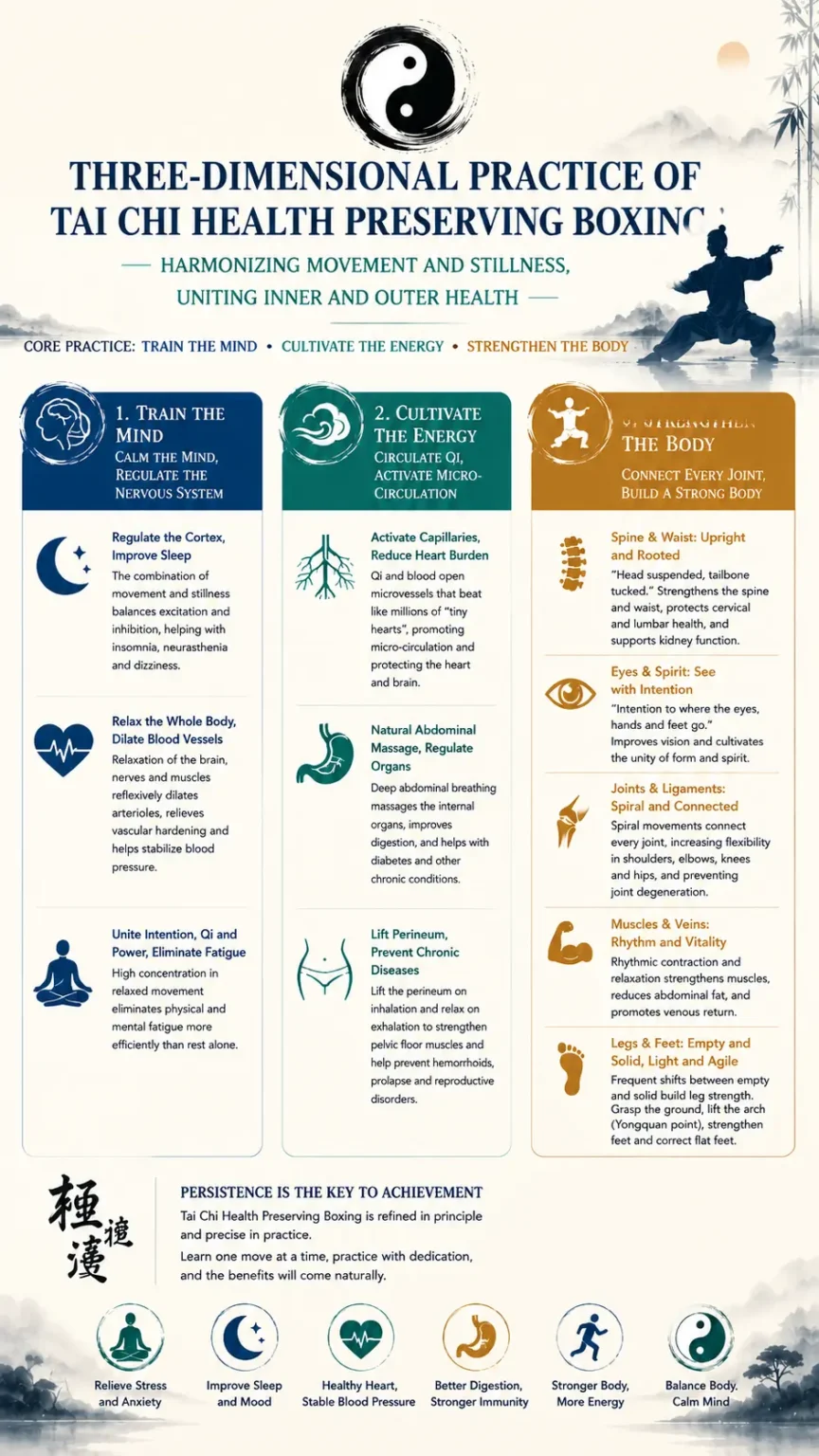
As a practice that cultivates both body and mind, Tai Chi is not merely the external performance of forms and movements, but also an internal cultivation of intention, energy, and strength. It integrates the scientific principles of both Eastern and Western medicine, and its core practice can be summarized in six words: train the mind, train the energy, and train the body.
I. Training the Mind: Using Stillness to Control Movement, Reshaping the Nervous System
Tai Chi is not just physical exercise; it is also a form of “mental meditation.” It demands mental focus and complete concentration, training the brain’s regulatory functions through the principle of “intention leading movement.”
Regulating the Cerebral Cortex and Improving Sleep: Tai Chi emphasizes “stillness within movement.” This practice, which combines movement and stillness, effectively regulates the excitation and inhibition of the cerebral cortex, offering significant therapeutic benefits for neurasthenia, insomnia, and dizziness.
Whole-Body Relaxation and Vasodilation: Practicing Tai Chi requires both mental and physical relaxation. Under the control of the cerebral cortex, the relaxation of nerves and muscles reflexively dilates small arteries throughout the body, effectively alleviating vascular sclerosis and helping patients with hypertension stabilize their blood pressure.
Harmonizing Inner and Outer, Eliminating Fatigue: During practice, one seeks to “unite intention with breath, and breath with strength.” This highly focused state of relaxation is more effective than simple rest in eliminating fatigue following both mental and physical labor.
II. Cultivating Qi: Circulating Qi from the Dan Tian to Activate Microcirculation—the “Mini-Heart”
The “cultivation of Qi” in Tai Chi involves, in a state of relaxation and stillness, using deep, slow breathing to circulate the Qi from the lower abdomen (Dan Tian) throughout the body in a spiral motion.
Activating Capillaries and Reducing the Heart’s Burden: The circulation of Qi and blood causes a large number of capillaries throughout the body to open. These microvessels pulsate rhythmically, as if millions of “micro-hearts” had been added within the body, effectively promoting microcirculation and preventing cardiovascular and cerebrovascular diseases.
“Self-massage” of the abdominal organs, regulating the spleen and stomach: Deep, prolonged abdominal breathing causes the diaphragm to rise and fall, providing a “massage” effect on the internal organs that medication cannot achieve, significantly improving chronic conditions such as indigestion and diabetes.
Anal Sphincter Breathing for Chronic Disease Prevention: By coordinating inhalation with a slight lifting of the perineum (“hoisting the crotch”), the alternating tension and relaxation of breathing effectively exercises the anal sphincter, providing excellent prevention and treatment for hemorrhoids, rectal prolapse, and chronic reproductive system disorders.
III. Physical Training: Integrating Every Joint to Build a Strong and Healthy Physique
Tai Chi imposes rigorous postural requirements on every part of the body. Through the practice of “unifying form and spirit,” it comprehensively enhances physical fitness:
Trunk and Lumbar Spine: Aim for “the crown of the head suspended, the tailbone tucked in,” aligning the Baihui acupoint and the perineum on a single vertical line. Through the practice of “using the waist to support the spine,” one can not only prevent and treat cervical spondylosis and lower back pain but also strengthen kidney function, thereby avoiding premature aging and a hunched posture.
Gaze and the Window to the Soul: Emphasis is placed on “intention, eyes, hands, and feet moving in unison.” Keeping the gaze level with the leading hand not only exercises the ocular nerves and improves vision but also embodies the essence of “unity of form and spirit.”
Joints and Ligaments: The rotating and coiling movements require “joint-to-joint continuity,” effectively enhancing the flexibility of the shoulders, elbows, knees, and hips while preventing joint degeneration.
Muscles and Veins: Rhythmic muscle contraction and relaxation not only build firm, powerful muscles and help eliminate a “potbelly,” but the resulting compression effect also promotes venous blood return to the heart.
Empty and Full in the Legs and Feet: Frequent shifts between “empty” and “full” states significantly boost lower-body strength. Alternating between gripping the ground with the soles and lifting the arches (slightly raising the Yongquan acupoint) thoroughly exercises the foot ligaments, corrects flat feet, and makes one’s steps light and agile.
💡 Conclusion: Success Lies in Perseverance, and Consistency Is Key
Tai Chi for Health is characterized by “precise principles and meticulous methods.” By learning and practicing each form one by one, and integrating movement with stillness, one can attain qi very quickly.
However, there is only one key to experiencing its miraculous benefits—consistency. Only by integrating Tai Chi practice into daily life, making it as indispensable as three daily meals, can one reach the highest realm of health cultivation: immunity to all illnesses, vibrant spirit, and a robust physique.