
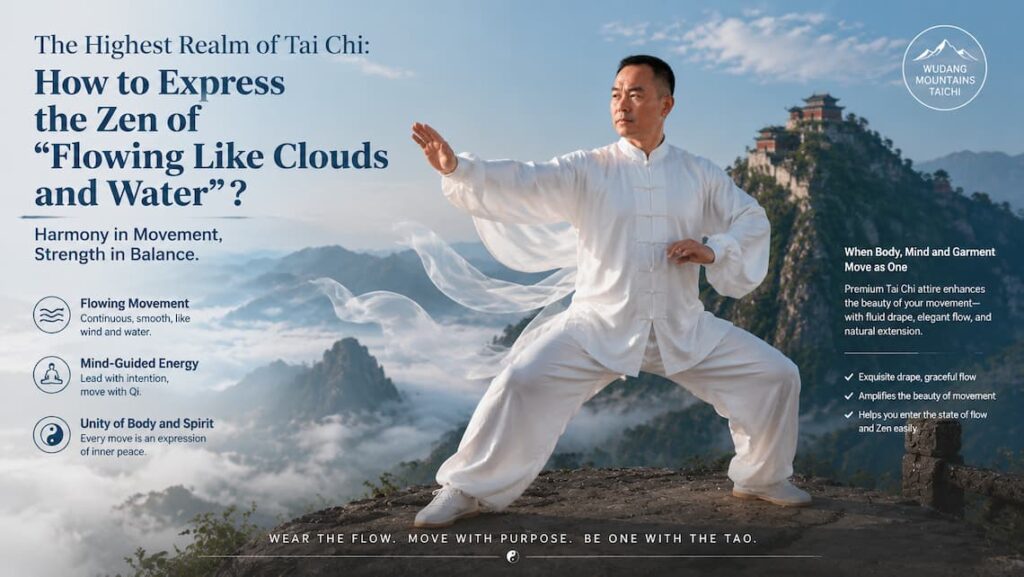
When many people first begin learning Tai Chi, they focus on whether the forms are standard and the movements are executed correctly. However, as practice deepens, they discover that what truly moves people is never the movements themselves, but rather the vitality and spiritual depth that emanate from them.
Tai Chi is hailed as the “Eastern Philosophy of the Body” precisely because it transcends mere martial arts combat to become a dynamic form of spiritual cultivation. In every move and posture, one cultivates not only the body but also the mind. As the saying goes, “Guide the qi with intention, and move the body with qi,” ultimately achieving the state of “unity of form and spirit.”
The most direct manifestation of this state is that Zen-like quality of flowing as smoothly as clouds and water.
The beauty of the movements lies in their “uninterrupted continuity.”
“Like the great rivers of the Yangtze and Yellow Rivers, flowing ceaselessly.”— The Treatise on Tai Chi Chuan
This not only describes the continuity of the movements but also elucidates the core spirit of Tai Chi Chuan—uninterrupted, unstiff, and seamless.
When observing a true Tai Chi master, you will rarely see obvious pauses or breaks. Every turn, every push, seems to grow naturally from the previous movement. There are no forced transitions between movements, only a fluid continuity.
This state is akin to clouds moving with the wind.
Clouds do not drift deliberately, yet they are always in motion;
water does not flow deliberately, yet it never stops.
What Tai Chi seeks is precisely this sense of naturalness that goes with the flow.
Guiding Qi with intention, allowing the body to become an expression of the mind
Many people mistakenly believe that Tai Chi emphasizes “slowness.” In reality, Tai Chi does not pursue slowness, but rather “composure.” The movements slow down merely to allow the mind to lead the body.
When the intention arrives first, the flow of energy follows, and the body naturally follows suit. At this point, the movements are no longer mechanical imitations, but become a true expression of one’s inner state.
Therefore, once Tai Chi reaches a certain level of practice, it manifests a very special kind of beauty—
Though seemingly gentle and slow, it contains an endless source of power; though seemingly calm and still, it maintains an inner flow at all times.
This is the most vivid embodiment of Eastern Zen philosophy.
Why Do Some People’s Tai Chi Movements Always Seem “Stiff”?
Many people perform the movements correctly, yet their practice still feels lacking in grace. The reason often lies not in the movements themselves, but in the overall presentation’s lack of a “sense of extension.”
Tai Chi emphasizes roundness, relaxation, and the opening and closing of the body. If the body’s lines are constrained, the movement’s trajectory tends to appear cramped; if the visual expression is too tense, the sense of flow is diminished.
This is why traditional Tai Chi has always emphasized the harmonious relationship between clothing and movement. Clothing is not merely something to wear; it is an integral part of the movement’s expression.
“The garment moves with the body; the body and garment become one.”
The beauty of Tai Chi lies in that sense of flow—“as delicate as drawing silk, as steady as a mountain.”
Whether you’re practicing in the park at dawn or performing a form in the training hall, every pushing palm and every turn of the body is an outward expression of inner tranquility. And this “flowing like clouds and water” aesthetic often requires visual extension to be fully realized.
Ordinary Workout Clothes
If you wear ordinary, form-fitting workout clothes, the trajectory of your movements can easily feel constricted, and the overall appearance becomes cramped.
Traditional Tai Chi Outfit
But when you switch to a traditional Tai Chi outfit with excellent drape, the situation is entirely different:
- As you extend your palm, the loose sleeves naturally unfurl with the force.
- When you turn, the hem traces a gentle arc.
- Upon concluding the movement, the hem gently settles back, as if the wind has ceased and the clouds have stilled.
A well-made Tai Chi uniform amplifies the aesthetics of movement
This visual tension—where “the garment moves with the practitioner, and practitioner and garment become one”—concretely manifests the inner energy and rhythm that were previously hidden within the body. What the viewer sees is not merely a series of movements, but a flowing artistic conception; what the practitioner feels is not just physical movement, but an immersive experience of mind and body as one.
The most important value of traditional Tai Chi attire lies not merely in its simple, elegant appearance. Truly excellent Tai Chi uniforms often possess outstanding drape and a sense of fluidity.
When movements unfold, the fabric naturally follows the body’s trajectory to form fluid lines; when movements conclude, it gently returns to stillness. In a sense, the attire does more than simply enhance the movements; it helps the body understand them.
The highest level of Tai Chi is when one resonates with nature
The ultimate goal of Tai Chi has never been a single perfect movement. Rather, it is a state of harmonious coexistence between humanity and nature.
In every gesture and movement, there is no striving, no haste, and no stagnation. When the wind blows, one moves; when the wind ceases, one is still. When movements no longer strive to display strength, but instead begin to express inner peace and composure, you will understand:
The highest realm of Tai Chi lies not in the complexity of techniques, but in allowing the body to become an extension of the mind—through every inhale and exhale, every opening and closing. And that Zen-like quality, as fluid as flowing clouds and water, will naturally manifest in every movement.